
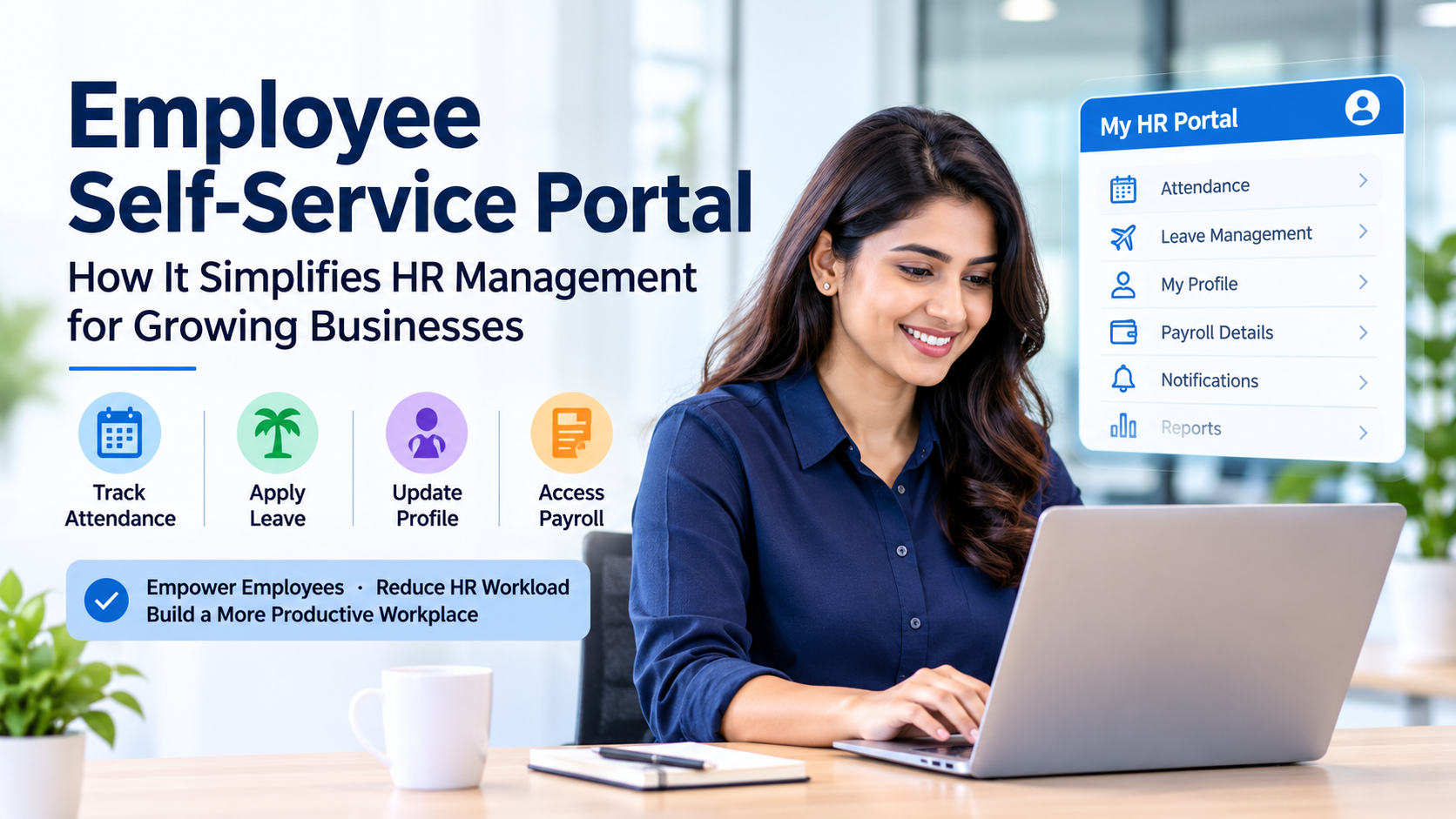
Managing employees involves more than maintaining attendance records and processing salaries. HR teams regularly handle leave requests, employee information updates, attendance corrections, document requests and other administrative activities. When these tasks are managed manually, they consume valuable time and create unnecessary delays.
An employee self service portal offers a practical solution by allowing employees to access important HR services through a centralised digital platform. Instead of depending on HR professionals for every small request, employees can manage routine activities independently.
For growing businesses, this approach improves communication, reduces repetitive administrative work and creates a more organised workplace. With modern HRMS solutions, companies can connect employee information, attendance, leave management and other HR activities in one system.
What Is an Employee Self-Service Portal?
An employee self-service portal is a digital platform that allows employees to access and manage their personal HR information without depending on HR staff for every update or request.
It acts as a central point where employees can view relevant information, submit requests and monitor their HR-related activities.
For example, an employee can use the portal to:
View attendance records and working hours.
Apply for leave and check approval status.
Update personal and contact information.
Access available salary and payroll information.
Review important company announcements.
Track requests submitted to the HR department.
An employee self-service portal reduces unnecessary communication and gives employees greater control over routine workplace activities.
Why Do Growing Businesses Need Employee Self-Service Software?
As companies expand, managing employee information through spreadsheets, emails and manual documents becomes increasingly difficult.
HR teams may spend several hours answering repetitive questions about leave balances, attendance records and employee details.
Employee self-service software helps address these challenges by providing a structured digital environment.
Here are some important reasons businesses should consider adopting it.
1. Reduces Administrative Work
HR departments often receive similar questions from multiple employees. Answering every request individually takes time away from recruitment, employee engagement and workforce planning.
A self-service platform allows employees to access commonly required information independently.
For example, instead of contacting HR to check leave balances, employees can view the available information through their portal.
This reduces repetitive communication and allows HR professionals to focus on more important responsibilities.
2. Improves Attendance Management
Maintaining accurate attendance records is essential for workforce management.
A digital employee attendance management system helps organisations maintain structured attendance information and improve visibility into employee working patterns.
Depending on the system's capabilities, employees and authorised managers can:
Review attendance information.
Identify missing attendance entries.
Submit attendance correction requests.
Monitor working hours.
Access attendance history.
This makes attendance tracking more organised and reduces dependency on manual registers.
3. Simplifies Employee Leave Management
Managing leave requests manually can create confusion, especially when several employees request leave simultaneously.
An HR self service portal provides a more organised approach to leave management.
Employees can submit requests digitally, while managers can review and approve or reject them according to company policies.
The process generally includes:
Employees select their leave dates.
They choose the appropriate leave category.
The request reaches the authorised manager.
The manager reviews the request.
Employees receive an update about the decision.
This creates better visibility and makes the employee leave management system easier to manage.
4. Improves Employee Information Accuracy
Outdated employee information can create problems during payroll processing, internal communication and workforce administration.
An employee management system provides a centralised place for maintaining employee records.
Employees can review their available information and submit updates where permitted.
HR administrators can verify changes and maintain consistent records.
Common information includes:
Contact details
Residential address
Emergency contact information
Employee identification details
Department and designation
Employment-related documents
The organisation should establish appropriate access permissions before allowing employees to update sensitive information.
What Features Should an Employee Self-Service Portal Include?
Not every employee self-service platform offers the same capabilities. Businesses should evaluate features based on their workforce requirements.
The following table highlights useful features to consider.
| Feature | Purpose | Business benefit |
|---|---|---|
| Employee profiles | Access employee information | Organised records |
| Attendance tracking | Review attendance details | Better visibility |
| Leave management | Submit and track leave requests | Faster processing |
| Payroll access | View available payroll information | Improved transparency |
| Notifications | Receive HR updates | Better communication |
| Document management | Access relevant documents | Reduced paperwork |
| Approval workflows | Route requests to managers | Structured decisions |
| Access controls | Restrict sensitive information | Better data protection |
A business should prioritise features that solve its existing HR challenges rather than choosing software simply because it offers numerous functions.
How Does an Employee Self-Service Portal Improve HR Productivity?
The biggest advantage of employee self-service software is its ability to reduce repeated manual interactions.
Consider a company with 100 employees. If each employee contacts HR several times a month for attendance, leave or personal information, the department must manage a continuous stream of routine requests.
A centralised portal can make these interactions more structured.
| HR activity | Traditional process | Digital self-service process |
|---|---|---|
| Leave application | Email or paper form | Online request |
| Attendance query | Contact HR | View attendance records |
| Profile update | Manual communication | Submit an update |
| Leave status | Ask the manager | Check request status |
| HR announcements | Individual messages | Centralised notifications |
The exact time savings depend on employee adoption, system configuration and existing processes. However, reducing repetitive administrative work gives HR teams more opportunities to focus on employee development and business priorities.
How Can Businesses Choose the Right Employee Self-Service Portal?
Choosing the right employee self-service portal requires understanding the company's current workforce management process.
A suitable platform should be easy to use, secure and flexible enough to support business growth.
Consider these factors before selecting software.
1. Ease of use
Employees should be able to find attendance, leave and personal information without extensive training.
2. Mobile accessibility
Employees working remotely or in different locations should be able to access relevant HR services conveniently.
3. Integration capabilities
Choose a platform that can connect employee information with attendance, payroll and other HR processes where supported.
4. Data security
Employee records contain personal information. Look for role-based permissions, secure access and appropriate data management practices.
5. Reporting capabilities
HR managers should be able to access useful workforce information without manually combining multiple spreadsheets.
6. Scalability
The software should support additional employees, departments and approval structures as the organisation grows.
Why Is Data Security Important in Employee Self-Service Software?
An employee self-service portal stores or provides access to information that should not be publicly available.
This may include contact details, employment records, attendance information and payroll-related data.
Businesses should establish clear rules for accessing, storing and updating this information.
Important practices include:
Give employees access only to their permitted information.
Provide managers with appropriate approval permissions.
Use secure authentication methods.
Maintain records of important administrative changes.
Review access permissions regularly.
Establish suitable data retention and deletion policies.
Indian businesses should also understand the applicable requirements under the Digital Personal Data Protection framework.
For reference, consult the official Digital Personal Data Protection Act, 2023.
A secure HR management system should support responsible information handling while making routine employee services convenient.
How Does OrbitO CRM Support Modern HR Management?
Businesses need more than isolated tools to manage their daily operations. They need connected systems that help different departments work together.
OrbitO CRM provides an integrated business management platform that combines CRM, HRMS, workflow automation and analytics.
Its HRMS capabilities include employee profiles, attendance management and leave requests. These functions help businesses organise important workforce activities within a connected workspace.
The platform also supports workflow automation across HR and other business processes, helping reduce repetitive administrative work.
Businesses exploring an integrated solution can discover the OrbitO CRM Product Suite to understand its available capabilities.
With a connected HR management platform, organisations can improve information visibility, simplify routine activities and establish more consistent internal processes.
What Are the Main Benefits of Implementing an Employee Self-Service Portal?
An employee self-service portal can deliver several operational benefits when properly implemented.
The most important advantages include:
Less paperwork: Digital requests reduce dependency on printed forms.
Faster communication: Employees can access relevant HR information independently.
Improved accuracy: Centralised records reduce scattered information.
Better visibility: Employees can track their requests and available records.
Reduced HR workload: Routine queries become easier to manage.
Improved employee experience: Employees have convenient access to everyday HR services.
Structured approvals: Managers can review requests through defined workflows.
The long-term value comes from combining these benefits into a consistent HR process rather than treating the portal as another standalone application.
Conclusion
Managing employee information and routine HR activities becomes increasingly challenging as a business grows. Manual attendance tracking, leave applications and repeated information requests can consume valuable time and reduce administrative efficiency.
An employee self service portal provides a practical way to simplify these activities. It gives employees convenient access to important HR services while helping HR departments maintain organised records and structured workflows.
Businesses should look for a solution that combines usability, security, attendance tracking, leave management and employee information management.
With an integrated platform such as OrbitO CRM, organisations can bring essential HR activities into one connected environment and build a more efficient workplace.
Ready to simplify your HR operations? Explore OrbitO CRM and discover how an integrated business management platform can support your organisation's growth.
Frequently Asked Questions (FAQ)
1. What is an employee self-service portal?
An employee self-service portal is a digital HR platform that allows employees to access personal information, check attendance, submit leave requests and manage routine HR activities independently.
2. What are the benefits of employee self-service software?
It reduces administrative workload, improves employee communication, simplifies leave management, provides attendance visibility and helps maintain organised employee records.
3. Can employees access attendance information through a self-service portal?
Yes. Depending on the software, employees can review attendance records, check working hours and submit correction requests through the portal.
4. Is an employee self-service portal suitable for small businesses?
Yes. Small businesses can use employee self-service software to organise HR activities, reduce manual paperwork and manage employee information as their workforce grows.
5. How does an employee self-service portal improve HR productivity?
It reduces repetitive HR queries by allowing employees to access information and submit requests independently. HR professionals can then spend more time on recruitment, workforce planning and employee development.