
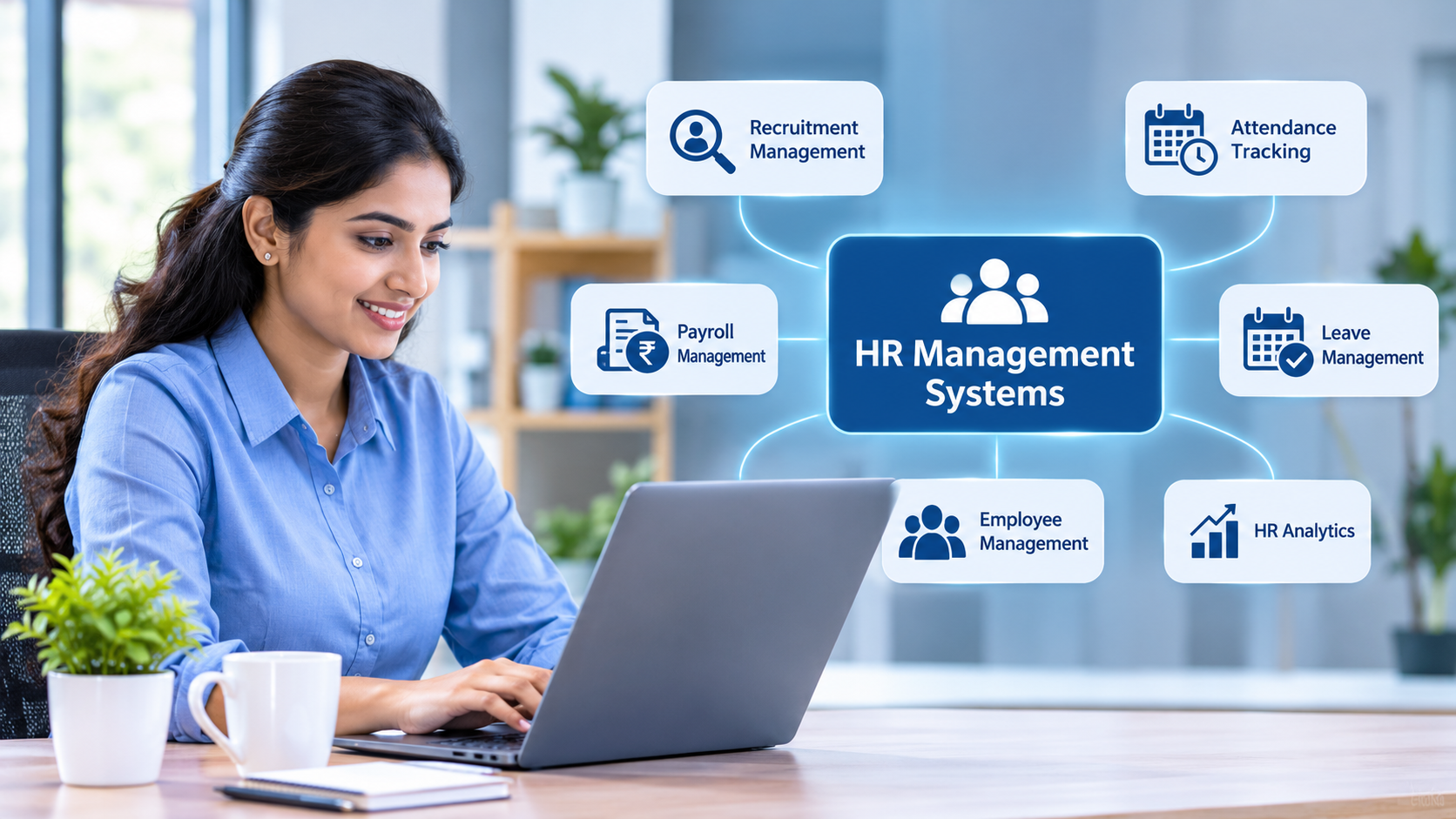
HR Management Systems simplify recruitment, payroll and attendance by automating employee records, candidate tracking, salary calculations, leave approvals and attendance monitoring. They help businesses reduce manual work, improve HR accuracy and manage employees more efficiently.
Free for 5 usersZoho PeopleManaging employees involves more than hiring people and assigning responsibilities. Businesses must handle recruitment, employee records, attendance tracking, salary calculations, leave requests and payroll administration. When these activities are managed through spreadsheets, paperwork and separate applications, HR teams often spend valuable time on repetitive administrative tasks.
HR Management Systems help businesses simplify these responsibilities by bringing important employee management activities into a central digital platform. They help HR professionals organise recruitment information, maintain employee records, monitor attendance and streamline payroll processes.
For startups, small businesses and growing organisations in India, adopting HR software can improve operational efficiency and make everyday workforce management easier. Instead of switching between multiple tools, businesses can manage essential HR activities through connected workflows.
This article explains how HR management systems simplify recruitment, payroll and attendance, their important features, and how businesses can choose the right solution.
What Are HR Management Systems?
HR management systems are digital software platforms designed to manage employee-related activities throughout the employment lifecycle. They help businesses organise workforce information, automate administrative processes and maintain accurate employee records.
An HRMS can include several modules depending on the software provider and subscription plan.
Common features include:
Employee information and document management.
Recruitment and candidate tracking.
Employee onboarding and offboarding.
Attendance and shift management.
Payroll processing and payslip generation.
Leave applications and approval workflows.
Performance management.
HR reports and workforce analytics.
Employee self-service portals.
By connecting these activities, HR teams can reduce duplicate data entry and access important employee information more easily.
How Do HR Management Systems Simplify Recruitment?
Recruitment involves several activities, including publishing job openings, reviewing applications, shortlisting candidates, scheduling interviews and managing offer letters.
When these activities are handled manually, recruiters may struggle to organise applications and follow up with candidates on time.
HR management systems with recruitment functionality help businesses organise the hiring process through digital workflows.
1. Centralised Candidate Information
Recruiters receive applications through multiple channels, including job portals, company websites and email.
An organised recruitment system can store candidate profiles, resumes, contact information and application details in one location.
This helps recruiters:
Access candidate information quickly.
Organise applications by job position.
Review candidate qualifications.
Track recruitment progress.
Reduce duplicate records.
A centralised candidate database also makes it easier to revisit suitable applicants for future vacancies.
2. Faster Candidate Screening
Reviewing every application manually can consume significant time, particularly when businesses receive hundreds of applications.
Recruitment software can help recruiters organise applications using filters such as skills, experience, qualifications and job requirements.
This makes it easier to identify suitable candidates and prioritise applications.
However, final shortlisting should involve human review to ensure candidates are evaluated fairly.
3. Better Interview Scheduling
Interview coordination often involves multiple emails, phone calls and calendar updates.
A recruitment workflow can help organise interview schedules, notify candidates and remind interviewers about upcoming meetings.
This reduces communication delays and helps recruitment teams maintain a structured hiring process.
4. Simplified Employee Onboarding
Recruitment does not end when a candidate accepts an offer. Businesses must also complete joining formalities and create employee records.
An HRMS can support onboarding by organising:
Employee registration details.
Joining documents.
Department assignments.
Reporting manager information.
Employment details.
Initial HR approvals.
This helps HR teams create a consistent onboarding experience for new employees.
How Do HR Management Systems Simplify Payroll Processing?
Payroll management is one of the most important HR responsibilities. Businesses must calculate employee salaries, account for attendance, apply authorised deductions and generate payslips accurately.
Manual payroll processing can become difficult as employee numbers increase.
HR management systems with payroll functionality help organise these activities through structured calculations and connected employee records.
1. Automated Salary Calculations
Payroll software can calculate employee salaries using configured salary structures, allowances, deductions and approved adjustments.
A typical payroll process includes:
Reviewing employee salary information.
Collecting attendance and leave records.
Recording overtime and applicable incentives.
Calculating gross salary.
Applying authorised deductions.
Reviewing payroll results.
Generating payslips.
Preparing salary payment information.
Automation reduces repetitive calculations, but payroll administrators should review results before approving salary payments.
2. Attendance-Based Payroll
One major advantage of connected HR systems is the ability to use approved attendance and leave information during payroll processing.
For example, if an employee takes approved unpaid leave, the relevant payroll adjustment can be calculated according to the company's salary policy.
This reduces the need to manually collect attendance details from separate spreadsheets.
3. Payslip Generation
Preparing individual payslips manually can increase the workload for payroll administrators.
Payroll software can generate digital payslips containing details such as:
Employee name and identification.
Salary components.
Earnings and allowances.
Applicable deductions.
Net salary.
Pay period.
Employees can access their payslips through supported employee portals or applications.
4. Payroll Compliance Management
Indian businesses must consider applicable payroll and employment-related requirements, including Provident Fund (PF), Employees' State Insurance (ESI), Tax Deducted at Source (TDS) and state-specific professional tax obligations where applicable.
Payroll software can help maintain records, apply configured calculations and prepare relevant reports.
However, businesses should verify current statutory requirements and ensure their software settings are accurate. Automation does not replace professional payroll review.
For official tax information, businesses can refer to the Income Tax Department of India.
How Do HR Management Systems Improve Employee Attendance Tracking?
Attendance management is essential for understanding workforce availability, monitoring working hours and supporting accurate payroll processing.
Traditional attendance registers and disconnected biometric reports can create additional work for HR departments.
An attendance management system helps businesses maintain digital attendance records and establish consistent attendance policies.
1. Digital Check-In and Check-Out
Employees can record their working hours through supported attendance methods, such as:
Web-based attendance portals.
Mobile applications.
Biometric attendance devices.
Integrated workplace attendance systems.
The available methods depend on the software and its integrations.
Digital records make it easier for HR teams to review employee attendance without depending entirely on manual registers.
2. Real-Time Attendance Monitoring
Attendance dashboards can help authorised managers review employee attendance information.
They may provide visibility into:
Employees present and absent.
Late arrivals.
Early departures.
Working hours.
Shift attendance.
Overtime records.
This information helps managers understand workforce availability and address attendance-related issues.
3. Automated Shift Management
Businesses with multiple departments or rotating shifts need an organised scheduling process.
HR software can help assign shifts, maintain employee schedules and identify attendance discrepancies.
For example, a company operating morning, evening and night shifts can organise employee schedules through predefined shift policies.
This reduces confusion and helps managers plan staffing requirements.
4. Better Leave and Attendance Coordination
Attendance and leave management are closely connected.
When employees apply for leave through a digital system, managers can review requests and HR teams can maintain updated leave records.
Depending on the platform, approved leave information can also be connected to payroll calculations.
Explore our guide on the Leave Management System for Small Businesses to understand how digital leave workflows improve HR administration.
What Are the Key Features of an Effective HR Management System?
Choosing the right HRMS requires understanding the features your business actually needs.
The following table highlights important capabilities.
| Feature | Business Benefit |
|---|---|
| Employee Database | Maintains organised employee information |
| Recruitment Management | Helps organise candidates and hiring activities |
| Onboarding Automation | Simplifies joining formalities |
| Payroll Management | Streamlines salary calculations |
| Attendance Tracking | Records employee working hours |
| Leave Management | Simplifies leave applications and approvals |
| Employee Self-Service | Allows employees to access permitted information |
| Performance Management | Organises employee reviews and goals |
| HR Reporting | Provides workforce information and insights |
| Workflow Automation | Reduces repetitive administrative work |
Not every HRMS includes all these features. Businesses should check the actual capabilities of their selected software plan.
What Are the Benefits of Using HR Management Systems?
HR management systems offer several advantages to organisations that want to improve workforce administration.
Reduced Administrative Work
Automating repetitive activities such as attendance recording, leave approvals and employee data updates helps HR teams save administrative effort.
Improved Payroll Accuracy
Connected employee and attendance records can reduce manual data entry and help maintain consistent payroll calculations.
Better Employee Experience
Employees can access available HR services, check leave information and retrieve payslips without repeatedly contacting administrators.
Organised Employee Records
A central database makes it easier to maintain employee details, joining documents and employment information.
Improved Management Decisions
Workforce reports can help managers understand attendance trends, employee availability and other operational information.
Easier Business Growth
As organisations hire more employees, HR responsibilities increase. A suitable HRMS helps businesses manage growing administrative requirements through structured digital workflows.
How Can Businesses Choose the Right HR Management System?
Selecting suitable HR software requires more than comparing feature lists. Businesses should evaluate their workforce size, existing HR processes, budget and future requirements.
Consider these steps before making a decision:
Identify business requirements: Understand whether recruitment, payroll, attendance or employee records need the most improvement.
Check essential features: Make sure the software includes the modules your organisation requires.
Review payroll capabilities: Check salary structures, deductions, payslips and applicable statutory requirements.
Evaluate attendance options: Confirm support for your working hours, shifts and attendance devices.
Check data security: Review access permissions, authentication, backup procedures and employee data protection.
Compare pricing: Consider subscriptions, setup fees, training, integrations and additional modules.
Request a demonstration: Test the software using realistic employee management scenarios before implementation.
The right solution should fit your existing business processes while supporting future workforce growth.
How Does Orbito CRM Help Businesses Simplify HR Management?
Orbito CRM provides a connected business platform that brings CRM, HRMS and workflow automation capabilities into one workspace.
Its HR-related capabilities help businesses organise employee profiles, attendance, leave activities and related administrative workflows.
With a connected platform, businesses can reduce the need to switch between separate applications for everyday operational activities.
Orbito CRM offers an integrated product environment that includes:
Core HRMS: Organise employee profiles and workforce information.
Attendance Tracker: Manage employee attendance activities.
Leave Tracker: Organise leave requests and related workflows.
Payroll: Access payroll-related capabilities within the business platform.
Performance Management: Support employee performance activities.
Workflow Automation: Connect repetitive business processes through automated workflows.
Businesses can explore the Orbito CRM product suite to understand its HRMS and business management capabilities.
Before implementation, organisations should confirm the specific recruitment, payroll, compliance and integration features available for their selected plan.
To learn more about managing employee records and salary administration, read our guide on HR and Payroll Software to Automate Business Tasks.
What Is the Future of HR Management Systems?
HR management systems are becoming increasingly important as businesses adopt digital workplace processes.
Modern HR platforms are moving towards connected workflows, employee self-service, automated notifications, workforce analytics and AI-assisted administrative processes.
Businesses can expect greater emphasis on:
Digital recruitment and onboarding.
Integrated attendance and payroll workflows.
Mobile employee self-service.
Automated HR notifications.
Data-driven workforce planning.
Improved employee information management.
These developments can help HR teams spend less time on repetitive administration and more time on employee engagement, workforce planning and organisational development.
Conclusion
HR management systems simplify important business activities by connecting recruitment, payroll, attendance and employee information through organised digital workflows.
They help reduce repetitive administrative work, improve employee record management and support more consistent HR operations.
For growing Indian businesses, choosing the right HRMS can make workforce management easier and more efficient. Before selecting a platform, evaluate its features, payroll capabilities, attendance options, security and pricing.
Orbito CRM offers connected HRMS and business automation capabilities to help organisations streamline everyday operations. Explore its product suite to see how a unified platform can support your business management requirements.
- ₹42 Zoho People Zoho People
| Option | Cost | timing |
|---|---|---|
| Manual HR management | Low initial cost | Immediate |
Serving Bangalore and nearby: Jp nagar, Bengaluru, Mg road, Bengaluru, Yelachenahalli, Bengaluru.
Expert advice
Do you need an Expert Content section for this HR Management Systems blog, including professional insights, practical recommendations and industry expertise to improve SEO and E-E-A-T?
Frequently asked questions
1. What are HR management systems?
HR management systems are digital platforms that help businesses manage employee records, recruitment, payroll, attendance, leave and other workforce-related activities.
2. How do HR management systems simplify recruitment?
They help organise candidate information, track applications, manage interview schedules and streamline employee onboarding through digital workflows.
3. Can HR management systems automate payroll?
Yes. HRMS platforms with payroll functionality can automate salary calculations, authorised deductions, attendance-based adjustments and payslip generation.
