
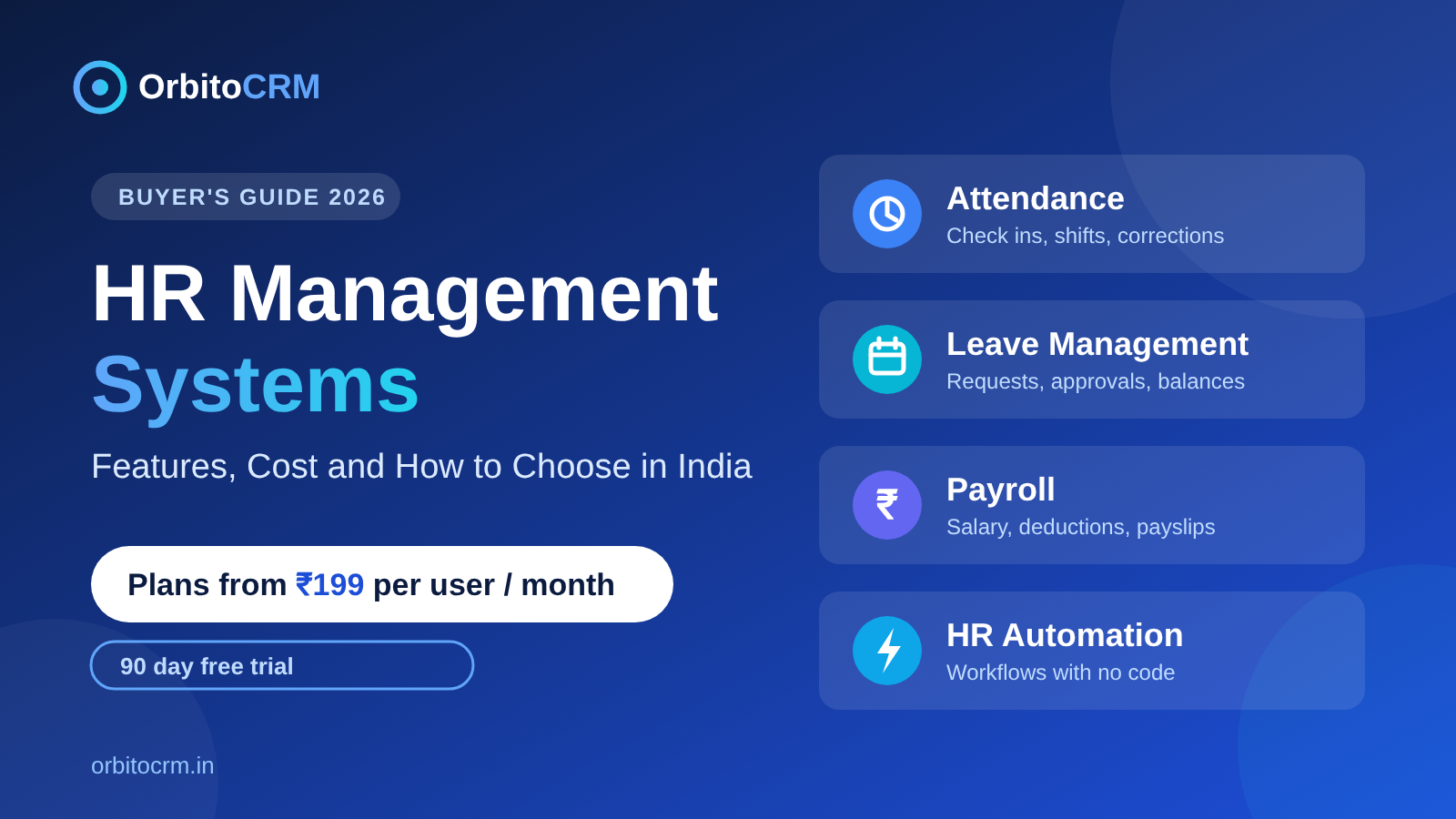
HR management systems are software platforms that store employee records and automate routine HR work such as attendance, leave, onboarding, payroll and performance reviews. They are also called HRMS software or HRIS. Every team member works from one shared record with controlled access, instead of passing files between departments.
Core featuresEmployee database, attendance tracking, leave management, payroll, employee self-service, reportingFree trial90 daysHR Management Systems: Features, Cost and How to Choose in India
Most HR teams in India do not lack ideas. They lack hours. Leave balances sit in one spreadsheet, attendance in another and payroll in a third, so every month end turns into a hunt for the right number. HR management systems solve this by keeping people data, attendance, leave and payroll in one connected place. This guide explains what they do, what they cost in rupees and how to choose one that your team will actually use.
What are HR management systems?
HR management systems are software platforms that store employee records and automate routine HR work such as attendance, leave, onboarding, payroll and performance reviews. They are also called HRMS software or HRIS. Every team member works from one shared record with controlled access, instead of passing files between departments.
Think of it as the single source of truth for your workforce. Managers approve leave from their phones, employees check payslips themselves, and HR spends its time on people rather than paperwork. If you want the fundamentals first, read our guide on what HRMS software is and how Indian businesses use it.
Why do businesses need HR management systems?
Businesses need HR management systems because manual HR work breaks as teams grow. Spreadsheets cause calculation errors, slow approvals and missed statutory deadlines, while a central system gives accurate data, faster workflows and a reliable audit trail.
Common warning signs include:
- Leave balances that employees and managers dispute
- Attendance corrections handled over chat or email
- Payroll that takes days to verify each month
- New joiners waiting on documents and system access
- Reports that HR must build by hand for every request
Rules also change. The government raised the EPFO wage ceiling from ₹15,000 to ₹25,000 per month with effect from 17 September 2026, as Business Standard reported, and the change landed in the middle of a payroll month. A system with configurable statutory settings lets you update one rule. A spreadsheet forces you to rebuild formulas and hope nothing breaks.
What features should HR management systems include?
The core features of HR management systems are an employee database, attendance tracking, leave management, payroll, employee self-service and reporting. Advanced options add performance management, workflow automation and AI assistants. Match the feature list to your current pain, not to the longest brochure.
| Feature | What it does | Why it matters |
|---|---|---|
| Employee database | Stores profiles, documents and job history | One accurate record for every person |
| Attendance management | Captures check-ins, shifts and corrections | Feeds payroll without manual entry |
| Leave management system | Handles requests, approvals and balances | Ends disputes over leave counts |
| Payroll software | Calculates salary, deductions and payslips | Reduces errors and month end stress |
| Employee self-service | Lets staff view payslips and apply for leave | Cuts routine HR queries |
| Performance management | Tracks goals, reviews and feedback | Makes appraisals consistent |
| HR automation | Triggers approvals and reminders automatically | Removes repetitive follow ups |
| Reports and analytics | Shows headcount, absence and payroll trends | Supports faster decisions |
Two of these deserve a deeper look. Our leave management system guide covers leave types and setup, and our overview of HR automation software shows how workflows remove repetitive tasks.
How much do HR management systems cost in India?
Most HR management systems charge per user or employee per month, plus a one time setup fee and GST. Entry plans in India often start at a few hundred rupees per user, while enterprise plans cost more because they add security, support guarantees and customisation.
Orbito’s published plans show the structure clearly:
| Plan | Price per user per month | Users | Notable inclusions |
|---|---|---|---|
| Starter | ₹199 | Up to 5 | Mobile app, email integration, community support |
| Professional | ₹499 | Up to 25 | Workflow automation, API integrations, priority support |
| Enterprise | ₹999 | Unlimited | Advanced security, SLA, dedicated support |
Every plan includes a 90 day free trial, and setup is ₹2,500 plus GST. Check the pricing page for current rates, and confirm which HR modules each plan covers during your demo.
Budget for these extras as well:
- Data migration from existing spreadsheets
- Training time for HR teams and managers
- Integrations with biometric devices, email or accounting tools
- Payroll add-ons that may be priced per employee
- GST on every invoice
Are HR management systems worth it for small businesses?
Yes, once HR tasks start eating into the working week. Small businesses gain the most from automating leave, attendance and payroll, because one error affects a larger share of the team and there is rarely a dedicated HR specialist to catch it.
Start with the modules that save the most time:
- Attendance and leave first
- Payroll once records are clean
- Automation after the basics are stable
How do you choose the right HR management system?
Choose by testing the system against your real workflows. Shortlist options that cover Indian statutory needs, work well on mobile, connect to your existing tools and show transparent pricing, then run your own data through a trial before you commit.
Use this checklist:
- Statutory fit: PF, ESI, TDS and professional tax handled correctly, with easy updates when rules change
- Ease of use: Employees and managers can finish tasks without training
- Mobile access: Leave, attendance and approvals from a phone
- Integrations: Email, calendar, biometric and accounting connections
- Security: Role based access and audit logs
- Support: Guided migration and a responsive team
- Scalability: Room to add users and modules as you grow
Smaller teams have specific needs, so see our guides to HR and payroll software for small businesses in India and HR and payroll software for startups.
How do you implement HR management systems step by step?
A successful rollout follows five steps: clean your employee data, define your policies, configure the system, train users and run one parallel payroll cycle before going live. Starting small and expanding module by module lowers risk.
- Clean and standardise employee records
- Write down leave, attendance and approval rules
- Configure the system and import data
- Train managers and employees in short sessions
- Run payroll in parallel once, compare results, then switch
For the full walkthrough, read our 7 step rollout plan for HR management systems.
What mistakes should you avoid when buying HR management systems?
The biggest mistakes are buying on price alone, skipping a trial with real data, ignoring statutory updates and neglecting user training. Each one leads to low adoption, and low adoption wastes the whole investment.
- Choosing the longest feature list instead of the right one
- Skipping input from managers and employees
- Importing messy data and expecting clean reports
- Treating go live as the finish line instead of the start
Once you are live, 7 ways HR management systems improve employee productivity shows where the payoff appears.
Why consider Orbito for HR management systems?
Orbito combines HRMS, CRM and automation in one workspace, so HR data connects to the rest of your business. Its HR tools cover employee profiles, attendance sync, one click leave approvals and performance logs, backed by no code workflows and AI agents.
Highlights include:
- Employee profiles, attendance and leave in a single portal
- Payroll and task tracking alongside HR records
- Visual workflow builder with no coding needed
- Role based access and audit logs for governed data
- A Bengaluru based team that supports data import and guided setup
- A 90 day free trial on every plan
Expert advice
HR management systems replace scattered spreadsheets with one connected platform for attendance, leave and payroll. Learn the key features, what they cost in India and how to choose the right one.
- ₹199 per user per month Orbito Starter (up to 5 users) OrbitO CRM Pricing
| Option | Cost | Timing |
|---|---|---|
| Spreadsheets and manual HR | No software fee. Cost is staff hours | Repeated every attendance, leave and payroll cycle. No published benchmark |
Serving Bangalore and nearby: Electronic city, Bengaluru, Mg road, Bengaluru, Jp nagar, Bengaluru.
Frequently asked questions
What are the main features of HR management systems?
The main features of HR management systems include an employee database, attendance tracking, leave management, payroll processing, employee self-service, and reporting capabilities.
How can HR management systems help small businesses?
HR management systems can help small businesses by automating time-consuming tasks like leave management, attendance tracking, and payroll, which reduces errors and saves valuable time.
Is there a free trial available for HR management systems?
Yes, Orbito CRM offers a 90-day free trial for their HR management systems, allowing businesses to test the software before committing.
How do I choose the right HR management system for my business?
To choose the right HR management system, evaluate your specific workflows, ensure it meets Indian statutory requirements, and test it with your data during a trial period.
What is the cost structure for HR management systems in India?
The cost structure for HR management systems in India typically involves a per-user monthly fee, a one-time setup fee, and applicable GST, with entry-level plans starting at a few hundred rupees per user.
